
Annapurna Circuit trek permits are the first thing to sort out before you set foot on this famous trail. You will be traveling through the green hills, high passes and small villages on this journey.
Most of the trekkers walk near peaks that are above 8,000 meters which is why this Annapurna trail is famous amongst all. Likewise, you will find local people very hospitable here.
This guide covers each and every permit you need for the Annapurna Circuit. You will know where to get each permit. You will find the cost of each one too.
explain the rules tied to each permit. By the end, you will know how to plan your trip and the rules tied to each permit .
In 2023, thousands of trekkers picked up permits through the Annapurna Conservation Area Project.
This shows how many people still choose this trek each year.
Since April 2023, new rules require every trekker to travel with a licensed guide. This change makes permit planning a bigger part of your trip prep.
Check out below the proper preparation that makes sure that your adventure is both memorable and responsible.
Why permits matter on the Annapurna Circuit Trek ?
Permits do more than let you walk on a trail. They are not just for your safety but in fact they protect the plants, animals, and villages that make this region.
If we look at the recent data , the Annapurna Conservation Area holds 1,226 species of plants and 474 species of birds.
Fees collected from permits pay for the improvement of infrastructure like trail repair, clean water systems, and waste removal in remote villages.
Likewise, Permits help rescue teams find trekkers who run into trouble.
Staff at checkpoints log each trekker who passes through.
To be fair this permit system saves lives in emergencies. The emergencies can be during storms, falls, altitude sickness or many more .
That’s why when you carry the right permits, you play a part in keeping the trail safe for everyone here in Nepal .
How Permits support local communities in the circuit ?
Permit fees do not just sit in a government fund.
A share of this money goes back into the villages along the trail.
Local schools, health posts, and water systems get support from this fund each year. Similarly, the trail bridges and rest stops along the route get repairs from this same fund collected from permits.
So, when you buy a permit, you help fund a ranger network that patrols the conservation area.
Rangers watch for illegal hunting and stop harm to rare plants and animals.
Your permit fee, in a small way, helps keep this region alive for the next group of trekkers who walk the same path in the coming years .
Basic Travel Requirements for the Annapurna Circuit Trek
A few basic preparations helps your trip go well before you fly to Nepal.
We have given below some of the tips for Annapurna Circuit Trek :
Valid Passport.
Your passport must stay valid for six months after you enter Nepal. Don’t forget to check the expiry date well before your flight date.
Nepal Visa
You need a visa to enter Nepal. You can get a tourist visa at Tribhuvan International Airport in Kathmandu.
You can get one at land border points too. Likewise you can apply for a visa on the Nepal immigration website before you fly, so you skip the airport line.
Trek Permits.
The Annapurna Circuit trek needs two main permits. These are the Annapurna Conservation Area Permit and the Trekkers' Information Management System card.
We cover both in full detail below.
Guide or Porter.
A guide is not just a nice extra anymore.
From April 2023, every trekker must travel with a licensed guide registered from TAAN .
This rule keeps every trekker safe on remote parts of the trail.
Health and Fitness Check.
The Annapurna Circuit crosses passes above 5,400 meters.
Good health and steady fitness help your body handle the thin air at that height.
Travel Insurance.
Travel insurance is mandatory. Buy a plan that covers your medical care, rescue, and trip cancellation.
High mountain passes carry real risks, so full coverage gives you peace of mind.
Gear and Clothing.
Always pack for hot lowland days and cold mountain nights. Carry warm layers, sturdy boots, rain gear, a water bottle, and a first aid kit.
Cash on Hand.
Carry both Nepali rupees and US dollars. ATMs sit only in Pokhara and a few larger towns. Small tea houses along the trail take cash only.
This avoids your unnecessary burden.
Why do you need Annapurna Trekking Permits in Nepal?
Everything has its own purposes. Likewise, getting permits for trekking in Nepal is just not about formality.
It has its own purposes that are good for you as well as the Annapurna Circuit.
We have given certain reason below :
Protecting the environment
The permit fees that are collected help in the conservation projects in the Annapurna Region.
Likewise, they help in the waste management projects, help in infrastructure and many more within the conservation area.
Trekking Trail maintenance
The revenue collected from permits is used to maintain trails, signs and shelters.
The well-marked trail makes your journey safer and accessible.
Supporting Local Communities
The permit fees also support the local communities that are within this Annapurna Conservation area.
Funds are also used to support local communities living within the conservation area.
This includes building schools, health posts and clean water projects so that tourism benefits the local people directly.
Safety Benefits and security
If you have Annapurna Permits with you it officially registers your presence on the trail.
So, if you get in an accident, illness or natural disaster, your entry in the permit database helps local authorities and rescue teams to locate you more easily.
Controlled Access:
The permit system helps to monitor the tourists coming every year.
It also manages the flow of tourists into environmentally sensitive zones, restricting the over tourism and minimizing ecological impact on this region.
Most of all, permits are one of the best ways to balance the environment and safeguard the trekkers.
All Permits required for the Annapurna Circuit Trail
The Annapurna Circuit trek needs a few permits.
Each one has its own motive. They are definitely protecting the region or keeping trekkers safe.
We have given below break down for each permit, its cost, and how to get it:
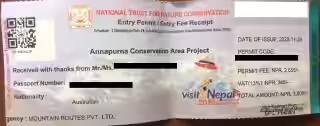
Annapurna Conservation Area Permit (ACAP)
The ACAP protects the plants, animals, and customs of the Annapurna region.
Every trekker needs this permit, even if their route only touches the conservation area for a short period of time .
Likewise, fees collected from the ACAP funds trail repair, clean energy projects, and waste removal along the route.
Without this permit, it is impossible to enter the Annapurna Circuit or the areas around it.
Where to get it:
You can get your ACAP in Kathmandu at the Nepal Tourism Board office or in Pokhara at the TIMS counter too.
How to get it:
● Documents needed: A passport copy, a passport photo, and the fee.
● Cost: NPR 3,000 (about USD 25) for trekkers outside SAARC countries.
NPR 1,000 for SAARC nationals.
Note : All you have to do is go to the NTB office in Kathmandu or the TIMS counter in Pokhara. Fill in the sheet or say forms. Hand in your documents. Pay the fee. Finally you will get your ACAP on the spot.
Trekkers' Information Management System (TIMS) Card
The TIMS card tracks trekkers along the trail. It helps rescue teams find you fast if something goes wrong. The wrongs can be any accident, illness or natural disaster.
It stops unlicensed trekking and keeps the trail system in order too.
Both solo trekkers and group trekkers need this TIMS card.
Where to get it:
You can get your TIMS card in Kathmandu or Pokhara at the Nepal Tourism Board or from the Trekking Agencies Association of Nepal office.
How to get it:
● Documents needed: A passport copy, a passport photo, and the fee.
● Cost: NPR 2,000 (about USD 15) for solo trekkers.
NPR 1,000 for trekkers who travel with a registered guide.
Note : All you have to do is Visit the NTB office in Kathmandu or the TIMS counter in Pokhara. Fill in the sheet. Hand in your documents. Pay the fee. Finally, your TIMS card prints right away.
Restricted Area Permit
Some spots near the Annapurna Circuit sit inside restricted zones. The restricted zones include Upper Mustang and Nar- Phu Valley.
These permits limit visitor numbers to protect fragile land and old customs.
Trekkers who enter these zones must travel with a licensed guide. It is mandatory to be with a guide.
The permit fee changes by location and by the number of days you plan to stay.
Where to get it:
You can apply for this permit in Kathmandu at the Nepal Tourism Board.
How to get it:
● Documents needed: A passport copy, a passport photo, and the fee.
● Cost: Between USD 10 and USD 100 per day, based on the zone.
Note : Like ACAP and TIMS you can apply through the Nepal Tourism Board in Kathmandu. Bring proof of your licensed guide, since the office checks for this.
Local Permits
A few villages along the Annapurna Circuit charge a small local fee.
Local leaders use this money to fix trails, manage water systems, and support the village.
Not every stop asks for this fee, but some checkpoints do.
This fee helps balance trek income with what each village needs.
Where to get it:
Pay this fee at local checkpoints along the trail.
How to get it:
● Documents needed: A passport copy and your ACAP.
● Cost: NPR 100 to 300 (about USD 1 to 3), based on the village.
Note : You have to stop at the checkpoint. Show your documents. Pay the small fee. A local staff member notes your entry.
Cost and Fees for Annapurna Circuit Trek Permits
Permit costs sometimes shift with season, permit type, and your nationality.
Every trekker needs an ACAP and a TIMS card.
If you plan to enter a restricted zone, such as Upper Mustang or Tsum Valley, you need a Restricted Area Permit and must pay local fees too.
The table below lists the latest fees.
Permit Type | Sep-Nov) | Dec-Aug | Fee: SAARC | Fee: Other | Notes |
|---|---|---|---|---|---|
Manaslu Restricted Permit (RAP) | USD 100 / first 7 days | USD 75 / first 7 days | - | - | Extra USD 15/day (Sep-Nov) or USD 10/day (Dec-Aug) past 7 days |
Manaslu Conservation Area Permit (MCAP) | - | - | NPR 1,000 | NPR 3,000 | Needed year-round in the Manaslu Conservation Area |
Annapurna Conservation Area Permit (ACAP) | - | - | NPR 1,000 | NPR 3,000 | Needed when you enter the Annapurna region |
Chumnubri Rural Municipality Fee | - | - | - | NPR 1000 | New fee for foreign trekkers that supports local development |
Tsum Valley Permit (Optional) | USD 35 / 7 days | USD 35 / 7 days | - | - | Extra USD 7/day for longer stays; applies if you trek through Tsum Valley |
TIMS Card (Optional) | USD 10 | USD 10 | - | - | Needed only if you continue to the Annapurna Circuit or Base Camp |
Documents checklist before you apply for Permits
You have to keep certain things before you head to the permit office, so your visit stays short and simple.
● Your passport, with at least six months left on it.
● Two to three passport-size photos, since offices ask for a fresh copy at each counter.
● A photocopy of your passport which is kept apart from the real one.
● Cash in Nepali rupees for the fee at each counter.
● Your guide's license number, if a licensed guide books your permit for you.
● Travel insurance papers, so you can show proof if a checkpoint staff member asks.
What to expect at trail checkpoints ?
The Annapurna Circuit has several checkpoints spread across the route.
You can expect staff at each post that asks for your ACAP and TIMS card. They keep track of your name, your route, and the date you pass through.
This process takes only a few minutes at most stops.
Staff may ask where you plan to sleep that night, since this helps rescue teams track trekkers who fall behind schedule.
Stay patient during busy months, since a group ahead of you may take a bit longer at the counter.
Keep your permits in a spot you can reach fast, such as a jacket pocket or a top pouch on your bag.
This step keeps the line moving and keeps your checkpoint stop short.
Common mistakes to avoid when you apply for permits
A few small mistakes that you might ignore knowingly or unknowingly can slow down your trek before it even starts.
We have given some common mistakes that can come handy for you and be alert :
Skipping the guide requirement.
Some trekkers still plan a solo trip without checking the April 2023 rule. So, book a licensed guide early, since this step is now a must for the full route.
Forgetting passport copies.
Staff at checkpoints ask to see your passport along with your permit. Make sure you carry a few extra copies in your day pack, just in case one gets lost or damaged.
Assuming one permit covers every zone.
The ACAP and TIMS card do not cover restricted areas like Upper Mustang.
Check your full route before you apply, so you do not miss a permit.
Waiting until the last minute.
Permit offices in Kathmandu and Pokhara can get busy during peak trek months like October.
Apply a day or two before your trek starts to avoid long hectic lines.
Losing track of permit copies.
Keep your permits in a dry bag or a sealed folder to avoid unnecessary problems. Rain and river crossings can damage paper permits fast.
Legal Consequences of Trekking Without a Permit
There are certain rules that need to be followed for Annapurna Region. Carrying the Annapurna Permits is one of them.
If you are thinking of trekking without ACAP permits, it is illegal under the Nepalese Law.
Below we have given some of the consequences incase if you miss them:
Fines for Trekking Without a Permit
There are several checkpoints along the trail like in Besisahar , Chame and Manang.
There are permit inspections at these check points. If the security personnel do not find the required documents, trekkers have to pay fines on the spot.
Entry Restrictions
There are possibilities that you cannot take your journey further and be stopped along the trail.
The authorities can return you back to the trailhead or nearest town to obtain permits. This not only wastes you time but also adds unexpected costs.
Legal Consequences and banning trekkers
There are some people who disobey the rules and regulations. Some are involved in permit fraud too.
Such trekkers face legal actions and are possibly banned from future trekking opportunities .
No emergency rescue support
There are official records of your permits on the trail. So, without permits you might lose the chance to get medical help.
Permit helps the local authority to locate where you are and assist you in difficult situations which may be an injury , illness , disasters or anything that is creating problems.
Permits are not just mandatory formalities, they are part of a combined system that protects both trekkers and the splendid Himalayan ecosystem.
Always carry your valid permits for your safety, legal observance and comfortable trekking experience.
Terms and Conditions for Annapurna Circuit Trekking Permits
A few rules apply once you hold your permits. Knowing them keeps your trek smooth and free of trouble.
Check out the terms and conditions below :
1. Every trekker must carry the ACAP and TIMS card on the Annapurna trail. You can't enter the Annapurna region without them.
2. Permits can't transfer or refund. Each permit carries the trekker's name. You can't pass it to another person. Once you pay the fee, you can't get it back.
3. Carry valid ID. Don’t forget to bring your passport and a passport photo when you apply for permits.
Keep a passport copy with you during the trek, since staff check it at various points.
4. Permits cover one route. Your permit works only for the route and dates listed on it.
A different area may need a new permit. Use outside these limits leads to a fine.
5. Follow conservation rules. The Annapurna region sits inside a protected area. Protect the environment . Skip littering, leave wild animals alone, and keep your footprint small.
6. One-time entry only. The ACAP and TIMS card work for one entry. If you leave the conservation area and plan to return, you need another new permit.
7. Show permits at checkpoints. Staff at trail checkpoints ask to see your permits. Skip this step, and you may face a fine or get turned away.
8. Fees stay the same by season. Permit costs stay steady through the year. Trail access and weather still shift by season, so check both before you set your dates.
Group permits vs Solo Trekker Permits
The fee you pay can shift based on how you trek.
Solo trekkers pay a higher TIMS fee than trekkers who join a group with a registered guide.
This gap in price comes from the extra tracking work staff must do for a trekker who walks without a guide.
A group trek brings other perks past the permit fee, too.
Guides in a group setting often split costs for porters, food orders, and room bookings at tea houses.
Likewise, solo trekkers handle each of these steps on their own, which can add time to each day on the trail.
As we have said previously , since April 2023, solo trekking without a guide is no longer an option on this route in any case, this rule change means most trekkers now fall under the group or guided rate for their TIMS card.
You can contact Mountain Routes or the Nepal Tourism Board for the latest rate that applies to your trip.
When is the best time to apply for your Annapurna Circuit Permits ?
Most trekkers apply for permits a day or two before they start the Annapurna Circuit Trek .
You will find Kathmandu and Pokhara offices stay open through the week, with shorter hours on weekends. However, the office remains closed during the public holidays.
Check the local calendar before you plan your permit visit, so you do not arrive at a locked door.
Some trek companies keep a small buffer day built into the trip plan for this reason alone.
Peak trek months fall in autumn and spring, so offices see more trekkers during these times.
If you want a comfortable trek apply early in the day to skip long lines.
For more ease bring exact cash in Nepali rupees, since offices may not have change for large bills.
If you travel with Mountain Routes , our staff handle all logistics on your behalf.
If your flight lands late in the day, plan your permit visit for the next morning instead of the same evening.
Office staff tend to close counters by late afternoon, and a rushed visit at closing time can lead to mistakes on your paperwork.
Conclusion
The Annapurna Circuit trek brings big rewards, but it also carries risks along steep passes and remote trails too at the same time.
Permits are for the safety of every trekker walking on the trail.
Our team handles your ACAP and TIMS card, so you skip the paperwork stress. We build a trek plan that fits your pace , your timeframe and your goals.
Likewise , you don’t have to worry about the acclimatization steps that help you prevent altitude sickness .
Mountain Routes is entirely prepared if any emergency comes up.
Contact us today and make your early bookings for the Annapurna Circuit Trek.
Frequently Asked Questions
Do I need a permit for a short trek on part of the Annapurna Circuit?
Yes, you need a permit even for a short trek on the part of Annapurna Circuit .At Annapurna even a short walk into the conservation area needs an ACAP.
Staff check permits at trail checkpoints, not just at the trailhead.
Can I get my permits before I fly to Nepal?
No. You must apply for the ACAP and TIMS card in person at the Kathmandu or Pokhara office. Don’t forget to bring your passport and a photo to speed up the process.
What happens if I lose my permit on the trail?
Report the loss at the next checkpoint if you lose your permit . Staff may ask you to pay a fee for a new copy. That’s why keep a photo of your permit on your phone as a backup.
Do children need a trek permit?
Yes, every trekker needs a permit, no matter what their age is.
Check with the Nepal Tourism Board for any child rate that may apply.
Is the TIMS card still needed if I have a guide?
Yes. The TIMS card and ACAP stay separate from your guide booking but you definitely need both the permits even with a licensed guide by your side.
How long does it take to get my permits?
Most trekkers get their ACAP and TIMS card within thirty minutes at each office. Wait times grow during peak trek months like in autumn or spring. Make sure you plan on time during such busy weeks..
Do I need a permit if I only visit Pokhara and skip the trek?
No, you do not need a permit if you just visit Pokhara and skip the trek . Permits apply only to trekkers who plan to walk inside the conservation area.
A trip to Pokhara city alone does not need an ACAP or TIMS card.

No comments yet. Be the first to share your thoughts!